
Hearing vs. Understanding: What the Speech Banana Can Show Us
What is a Speech Banana?
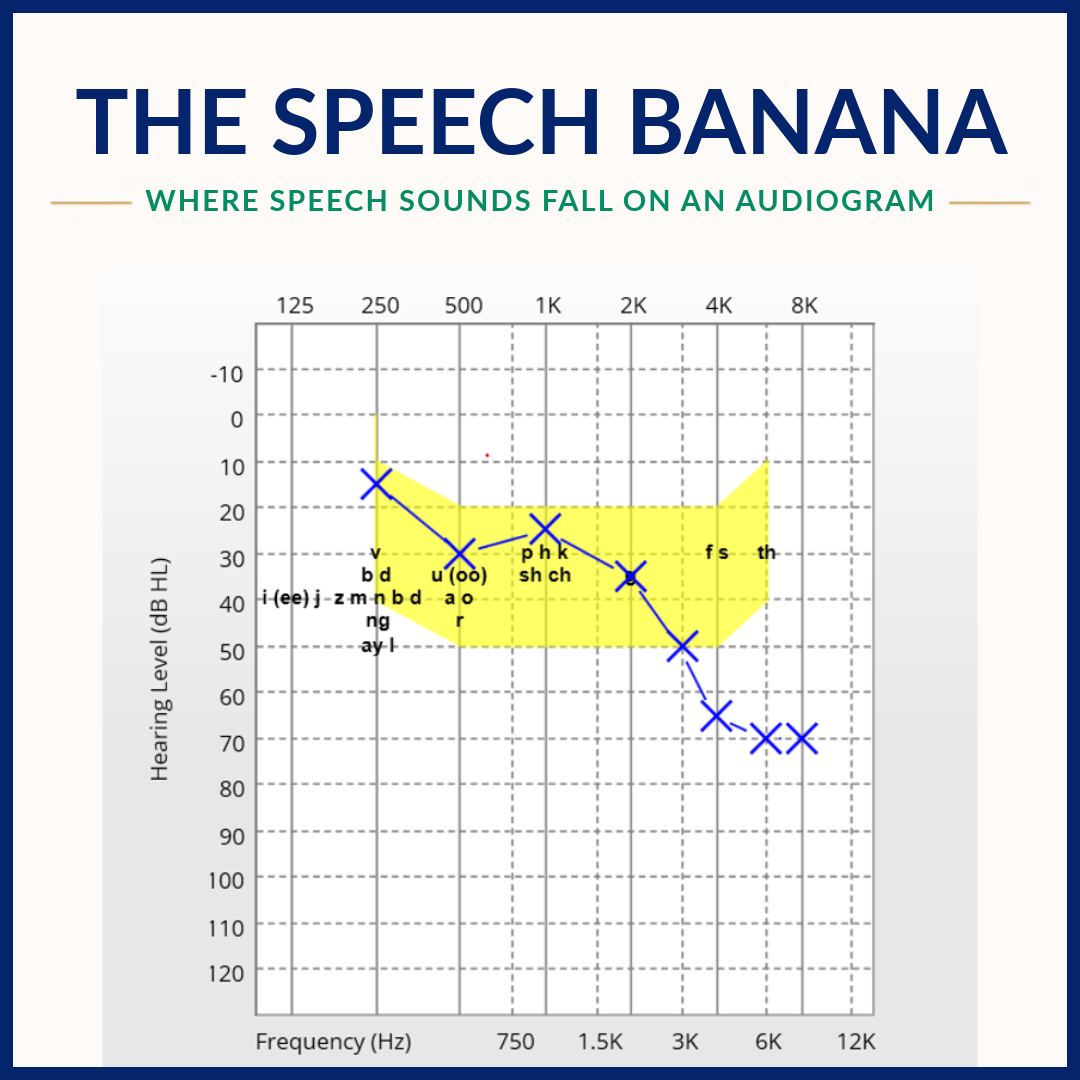
The speech banana is one of the most helpful tools used to explain hearing. It is simply a visual guide that shows where the sounds of everyday speech fall on an audiogram. If you imagine a banana laid across the audiogram, it covers the pitches and loudness levels where many speech sounds naturally occur at an average conversational level.
Not all speech sounds are created equal. Vowel sounds such as "ah" and "oo" are generally louder and lower in pitch, making them easier to hear. Consonants such as "s," "f," "th," and "t" are much softer and higher in pitch. These sounds may seem small, but they carry much of the clarity that helps us tell words apart.
For example, if you cannot hear the "s" at the end of a word, "cat" and "cats" may sound the same. You may hear that someone is speaking, but miss important details that help the brain understand what was actually said.
This is why hearing loss is not simply about volume. Many people say, "I can hear people talking, I just can’t understand them." That is often because some of the softer speech sounds may no longer be reaching the brain clearly.
The speech banana provides a simple way to relate a person’s hearing levels to the range of sounds that make up everyday speech. By comparing hearing thresholds with where different speech sounds typically occur, it can help illustrate why certain parts of speech may be less audible or more difficult to distinguish. It also helps explain why hearing aids are programmed differently for every individual. The goal is not simply to make everything louder, but to restore access to the range of speech sounds the brain needs for clearer communication.
By putting hearing test results into the context of everyday speech, the speech banana can make an audiogram easier to understand. What may initially look like a page of lines and symbols becomes a useful picture of how hearing levels can affect access to conversation—and why certain voices, words, or speech sounds may be more difficult to follow.
Written by: Shayna Swift, BA, MSc
Board-Certified Audiologist
Webster Street Hearing Boutique
Published: August 12, 2026
Share This Post
Ready for a more refined hearing experience?