Workplace Noise & Hearing Loss: What Nova Scotians Should Know

Workplace Noise: The Hearing Damage You May Not Notice

May is National Speech-Language-Hearing Month — an important reminder that hearing health is not just about aging. For many people, hearing damage begins gradually through everyday workplace noise exposure long before any noticeable hearing difficulties develop.


From construction sites and farms to restaurants, fitness studios, dental clinics, childcare centres, emergency services, and manufacturing facilities, workplace noise is more common than many realize. In Nova Scotia, prolonged exposure to excessive workplace noise remains one of the most preventable causes of permanent hearing loss. 

How Loud Is Too Loud?

In most Canadian workplaces, 85 decibels (dBA) over an 8-hour workday is considered the level where hearing protection and hearing conservation measures should begin. 


To put that into perspective:

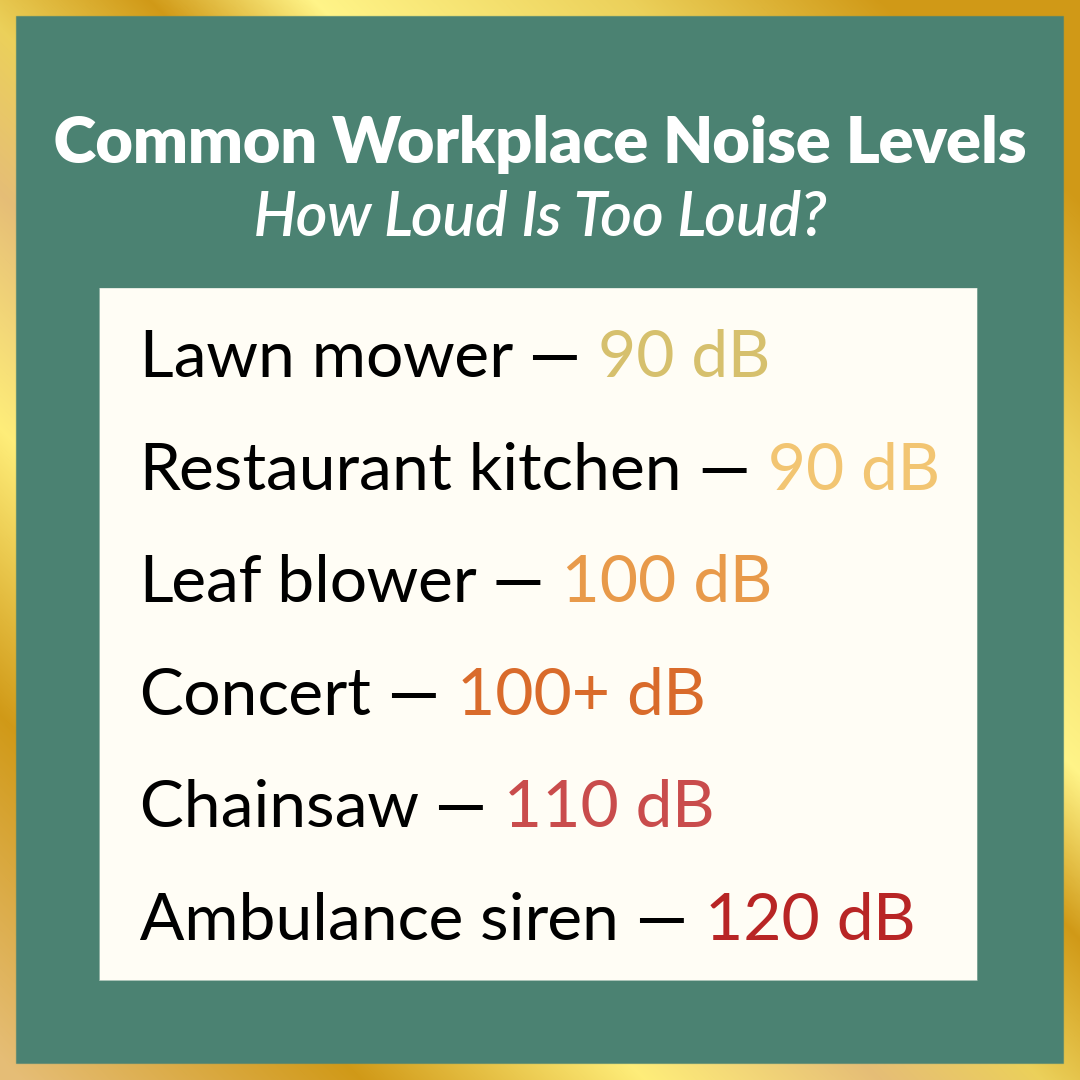
  • Lawn mower: approximately 85–90 dB 
  • Leaf blower: approximately 95–100 dB
  • Chainsaw: approximately 100–110 dB
  • Concerts and nightclubs: often over 100 dB 

One important thing to understand is that as noise levels increase, the amount of safe exposure time decreases significantly. A few minutes of very loud noise can potentially be enough to damage hearing over time.


The Hearing Loss You Often Don’t Notice

Noise-induced hearing loss usually develops slowly and painlessly. Many people assume their hearing is fine because they can still hear conversation in quiet settings. However, early hearing damage often affects the ability to hear higher-pitched sounds and understand speech clearly in background noise. 


Some early warning signs include:

  • Ringing or buzzing in the ears (tinnitus) 
  • Muffled hearing after work 
  • Difficulty understanding speech in noisy environments 
  • Frequently asking others to repeat themselves 
  • Feeling mentally fatigued after a noisy shift 

Hearing damage can occur long before a person realizes there has been a change.

Noise Affects More Than Just Hearing

Excessive workplace noise does not only impact the ears. Research and workplace safety organizations have also linked prolonged noise exposure to:

  • Increased stress and fatigue
  • Reduced concentration
  • Communication difficulties
  • Increased workplace accident risk
  • Mental exhaustion at the end of the workday

For many workers, constant background noise becomes “normal,” even when it is placing strain on both hearing and overall wellbeing.


Hearing Protection Only Works If It’s Worn Properly

Hearing protection can be extremely effective — but only when it fits correctly and is worn consistently. Even brief periods without protection in loud environments can significantly reduce its effectiveness.

Different jobs require different types of protection. Depending on the workplace, options may include:

  • Foam earplugs
  • Reusable filtered earplugs
  • Earmuffs
  • Custom hearing protection

Custom hearing protection can be especially helpful for individuals who need to communicate clearly while still reducing harmful noise exposure. This may include tradespeople, musicians, dental professionals, first responders, farmers, and industrial workers.


Can You Check Noise Levels Yourself?

Surprisingly, yes — to a degree. There are smartphone apps designed to help people better understand their noise exposure levels. One of the most widely recognized is the NIOSH Sound Level Meter developed by the U.S. National Institute for Occupational Safety and Health (NIOSH). Research has shown the app can provide reasonably accurate measurements, particularly on compatible devices, and it has been studied in peer-reviewed research settings. While smartphone apps should not replace professional workplace noise assessments, they can be a useful educational tool to help identify environments that may place hearing at risk.


Some signs your environment may be too loud include:

  • You need to raise your voice to speak to someone nearby
  • Your ears ring after work
  • Speech sounds muffled after a shift
  • Coworkers routinely wear hearing protection
  • You feel mentally drained from noise exposure


If you are curious about your environment, a sound level app can be a good starting point for awareness.


Protecting Your Hearing Starts Early

Noise-induced hearing loss is permanent — but it is also highly preventable. The earlier hearing protection becomes part of daily routine, the better the long-term outcome for hearing health. Whether you work in construction, healthcare, manufacturing, farming, transportation, hospitality, education, or emergency services, protecting your hearing today helps preserve communication, connection, safety, and quality of life for years to come.


At Webster Street Hearing Boutique, we are passionate about helping Nova Scotians protect and preserve their hearing through hearing assessments, education, and personalized hearing protection solutions designed for both everyday life and the workplace..


Published: May 6, 2026


References:

Canadian Centre for Occupational Health and Safety (CCOHS), Hearing Protection and Noise Exposure Resources https://www.ccohs.ca


Nova SAFE, Workplace Noise and Hearing Conservation Information https://www.novasafe.ca/en/topics/noise


National Institute for Occupational Safety and Health (NIOSH), Sound Level Meter App Information https://www.cdc.gov/niosh/noise/about/app.html


Kardous CA, Shaw PB. Evaluation of smartphone sound measurement applications, National Library of Medicine / PubMed Central https://pmc.ncbi.nlm.nih.gov/articles/PMC12749573/
Share This Post

Ready for a more refined hearing experience?

Discover what’s possible when care is tailored to you.
Book a Consultation
By Magdalena Kujath August 17, 2026
Managing Tinnitus With Hearing Aids
By Magdalena Kujath August 17, 2026
The Connection Between Tinnitus and Hearing Loss
By Magdalena Kujath August 17, 2026
Bimodal Neuromodulation: An Exciting New Direction in Tinnitus Support
By Magdalena Kujath August 17, 2026
What Does Heart Health Have to Do With Hearing?
August 12, 2026
Discover how the speech banana helps explain your hearing test and why certain speech sounds may be harder to hear and understand.
April 24, 2026
Protecting Those Who Protect Us First responders—paramedics, firefighters, police officers, and frontline medical professionals—work in environments defined by urgency, unpredictability, and often, intense noise exposure. From sirens and engines to alarms and chaotic scenes, their hearing is constantly under strain. Yet, hearing health is an often-overlooked aspect of occupational wellness in this population. At its core, audiology care for first responders is about preservation, performance, and quality of life. Repeated exposure to high-decibel environments places first responders at increased risk of noise-induced hearing loss . Hearing conversation in the presence of background noise can become especially difficult for individuals with this type of hearing loss. Another critical concern is tinnitus , commonly described as ringing or buzzing in the ears. For many first responders, tinnitus can become a persistent companion. Hearing Protection That Works in the Real World Traditional hearing protection can be impractical in emergency situations where situational awareness is critical. Fortunately, modern solutions offer a balance between protection and performance. Custom filtered hearing protection is designed to reduce harmful noise while preserving the ability to hear speech and environmental cues. Advanced filtered earplugs and electronic protection systems allow first responders to remain fully engaged in their surroundings, without compromising long-term hearing health. Amplified Stethoscopes For many in healthcare and emergency medicine, auscultation is a vital diagnostic tool. Amplified stethoscopes provide enhanced sound clarity, allowing clinicians to detect subtle findings even in noisy environments or in the presence of mild hearing loss. These devices can be transformative—restoring confidence, improving diagnostic accuracy, and extending the longevity of a clinician’s career. Proactive Care Baseline hearing assessments and regular follow-up testing are essential for early detection and intervention. Audiologists can identify subtle changes and offer tailored strategies that support both hearing preservation and occupational performance. First responders play a vital role in keeping our communities safe, often in high-noise, high-demand environments. Through proactive care and precision-fit hearing protection, we can help safeguard their hearing without compromising performance. At Webster Street Hearing Boutique, our custom-fit earplugs are designed to protect against harmful noise while preserving critical situational awareness—supporting both safety on the job and long-term hearing health. For personalized hearing protection solutions, contact Webster Street Hearing Boutique at (902) 678-5550—our team would be pleased to guide you.